The Young's Modulus
Young's Modulus
The Young's Modulus of a material is a fundamental property of every material that cannot be changed. It is dependent upon temperature and pressure however.
The Young's Modulus (or Elastic Modulus) is in essence the stiffness of a material. In other words, it is how easily it is bended or stretched.
To be more exact, the physics and numerical values are worked out like this:
Young's Modulus = Stress / Strain
where:
Stress = force / cross sectional area
Strain = change in length / original length
when graphed, the resulting plot will look something similar to this: 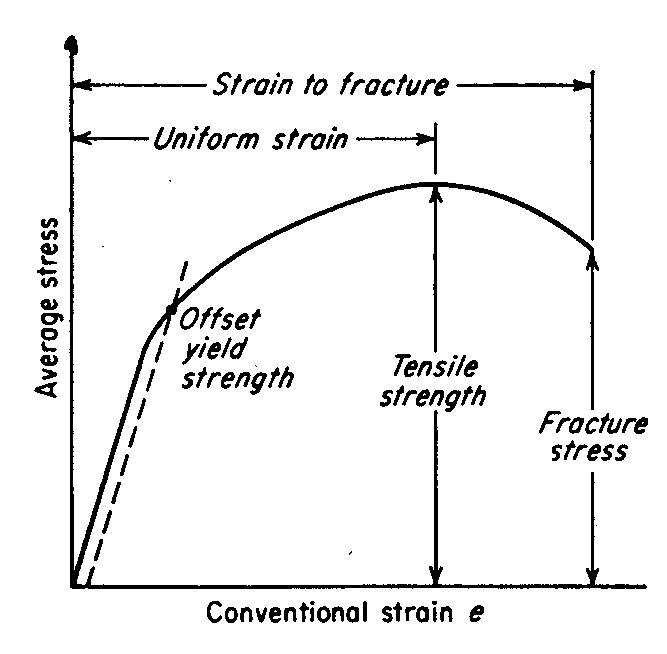
The Young's modulus is the slope of the initial section of the curve (i.e. m in y = mx + b).
When a material reached a certain stress, the material will begin to deform. It is up to point where the materials structure is stretching and not deforming. However, if you are to stress the material more than this, the molecules or atoms inside will begin to deform and permanently change the material.
A good analogy to this would be a rubber band: when you stretch a rubber band you are not deforming it, but stretching it. However, if you pull it too hard the rubber band will begin to deteriorate, or deform. Usually when this happens, it is not too much longer until it breaks.
Why Important?
The Young's Modulus is very important to doctors and scientists as this constant can tell them when a structural implant will deform.
Young’s Modulus. (s. f.). University of Washington. Recuperado 22 de agosto de 2021, de https://depts.washington.edu/matseed/mse_resources/Webpage/Biomaterials/young%27s_modulus.htm
Young’s modulus | Description, Example, & Facts. (s. f.). Encyclopedia Britannica. Recuperado 22 de agosto de 2021, de https://www.britannica.com/science/Youngs-modulus


Comentarios
Publicar un comentario